Quantum V2 CNC Router
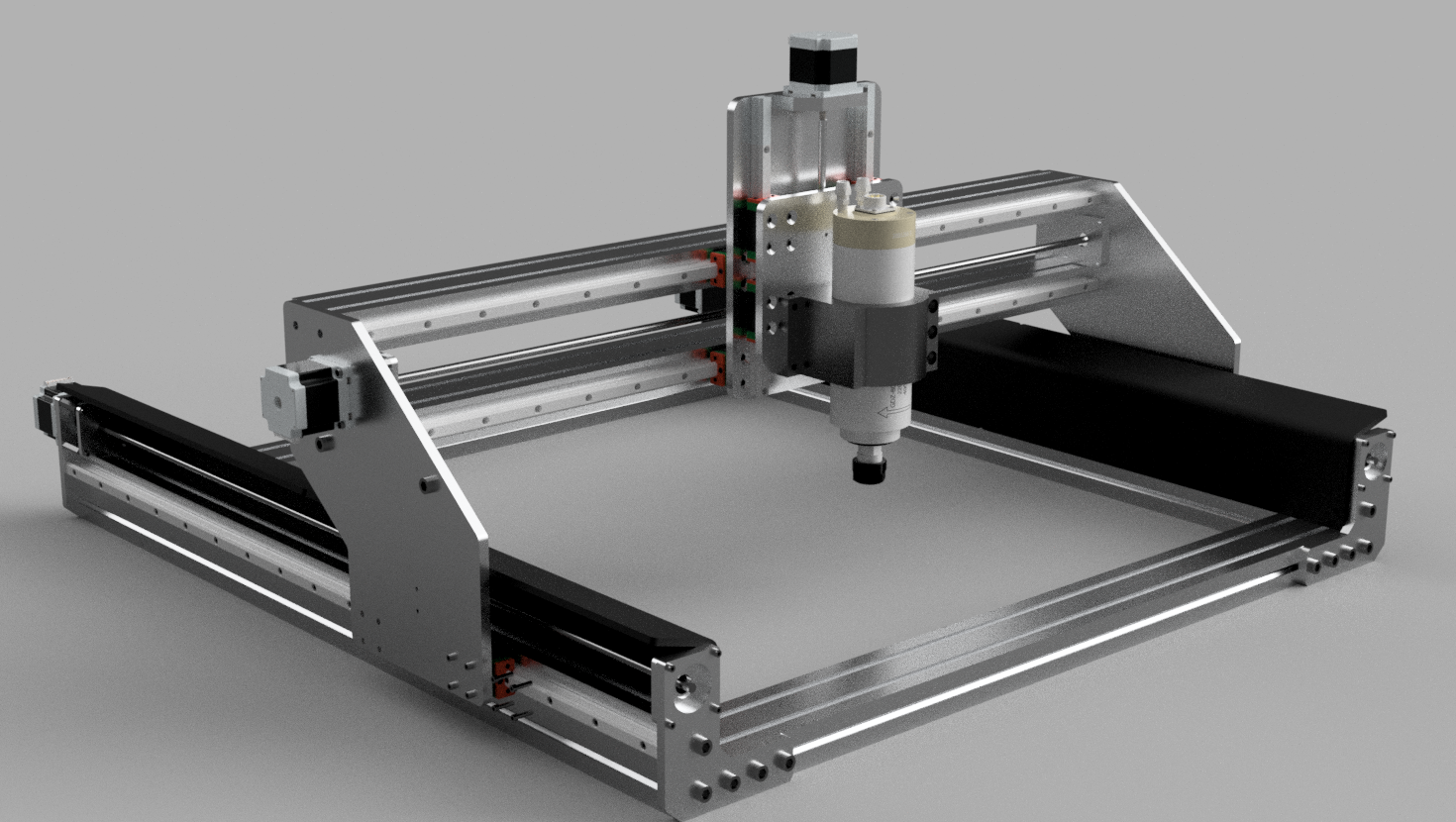
Quantum V2 is a CNC router designed by an FRC team, for FRC teams. This CNC is intended to provide a cost effective and smooth introduction into CNC machining with a useable footprint and an easy to maintain design. We designed Quantum in conjunction with FRC team 7501 with the goal of enabling lower resource teams to be able to manufacture their own parts to build better robots and teach their students valuable skills that they can use in their future careers.
Machine Build
Quantum V2 is available in 2 versions, the 400×400mm cutting area version and the 800×800mm cutting area version. Both machine variations use the same plate design and hardware, the only major difference is the length of the extrusions, linear rails, and screws that are used. Since much of the hardware is common between the two designs, the 800×800mm cutting version is not significantly more expensive than the smaller design, meaning that teams can build their own machine capable of cutting a 32×32” aluminum plate for a much lower price than any machine currently on the market. Something to note is that the smaller 400×400 version of the machine is more rigid than the larger machine, so teams that intend to use their Quantum as a milling machine may have better performance with the smaller version.
The original Quantum V1 was built with 4040 extrusion. While this worked, we noticed some deflection and chatter when cutting aluminum on the 800×800 configuration, and as a result we changed the V2 machine to 4080 extrusion. While doubling the thickness in one axis doesn’t sound like a tremendous change this adjustment nearly quadruples the bending and torsion resistance along the X gantry, resulting in a far cleaner cutting experience with less chatter.
Quantum uses a tensioned screw system for linear motion, meaning that the driving screw for each axis is preloaded to eliminate screw “whip” and ensure that no backlash develops in the machine. This preload is done using machined bearing plates that contain a radial and thrust bearing package, ensuring that all contact surfaces are properly constrained and can handle the applied forces without damage. One of the compromises made on Quantum is the use of 8mm lead screws over something like ballscrews. While ballscrews tend to provide a faster linear feed and more efficient power transfer, the cost of high quality ballscrews would have ballooned the machine price to something that is not conducive with our mission of producing an affordable machine for FRC teams. To limit the disadvantage of leadscrew over ballscrew, we selected a combination of high lead (distance per rotation) of 8mm and specialized POM anti-backlash nuts to ensure that motion is kept smooth and fast enough for moderate speed rapids. Practically, the difference between this machine and a similar ballscrew driven machine is relatively minor, mostly showing up in the sound of the machine when it is moving and with slightly slower peak movement speeds.
To ensure that Quantum is as rigid and smooth as possible, we chose to use HGR15 linear rails on the V2 machine. The original machine used SBR12 supported rods, and while this worked well it would occasionally lead to some flex in the gantry at high cutting loads. The HGR15 rails used on the new machine provide excellent torsion resistance as well as linear constraint, which dramatically stiffens the frame of the machine.
Quantum V2 does not currently ship with a work surface, so teams will need to provide this themselves. For beginners, our recommendation is to support a piece of MDF or plywood with some additional sections of 4080 extrusion between the front and rear frame segments. This MDF acts as a “spoil board” allowing you to screw parts directly into the work surface for fixturing without fear of damaging anything important when cutting through material.
Spindle
Quantum is designed to use either a 500W, 1.5Kw, or 2.2Kw spindle motor for cutting.
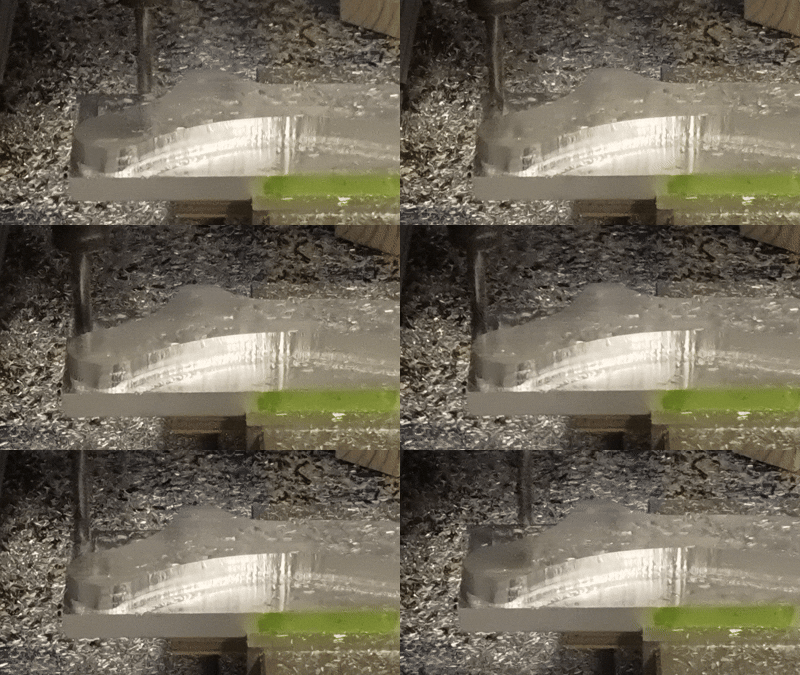
The 500W spindle is ideal for teams that intend primarily to cut plastics and are power limited in their workspace. While this spindle can cut metal (we use our 500W prototype machine to pocket aluminum tubes very often), it will struggle with slotting and have a slow material removal rate.
The 1.5Kw spindle provides a moderately powerful solution for cutting aluminum and other soft metals at decent speeds. This spindle draws low enough current that the machine can still run on a standard 110V 20A circuit, yet it has most of the power necessary for anything a robotics team would likely need to cut.
The 2.2Kw spindle is a slightly more powerful option for teams that want to push as much performance out of their machine as possible. On top of being more powerful, this 80mm spindle with ER20 collets is lower runout and more rigid, meaning that more aggressive cuts can be taken without inducing chatter or other issues.
Chip Management
Chips and dust from cutting is a significant problem for many DIY machines, as it can find it’s way into bearings, screws, and other moving parts to cause damage and prevent smooth motion. As Quantum is a gantry style machine, the Y axis screws and rails are the most vulnerable areas of the machine to chip ingress. Because of this, we added a machined plastic side guard system to prevent chips from falling directly into the Y axis motion components during cutting. These guards prevent almost all chip ingress (any chip that can clear the guard will fall out of the machine) and are less likely to tear or fatigue over the lifespan of the machine than bellows.
Quantum does not currently ship with a part coolant or reservoir system, however this is something we are considering adding for future versions. For now, thermal management must be handled via careful chipload or via manual coolant spraying. For difficult cuts, we often use spray bottles with cutting oil or Ethanol to keep the cut area cool and lubricated.
Learning to use a CNC
Learning to use a CNC machine can be an intimidating task, as improper use can damage tools, ruin parts, or even break the machine itself. As a result, we are working with team 7501 to develop a CNC training course and reference guide specifically for the Quantum V2. In particular, this guide will go over; how to tram and calibrate the CNC, introduction to GRBL-HAL and G-sender, programming CAM (with Autodesk Fusion CAM), calibrating feeds/speeds, and troubleshooting issues.
Pre-orders for Quantum V2 kits are open now in our equipment store, and 20% of all profits are donated directly to FRC team 7501 to help support their robotics program and teach the next generation of engineers, innovators, and skilled tradespeople.